Since January of 2017, Republicans have controlled both houses of Iowa legislature and the governorship. This month, the legislature passed tax cut legislation sharing elements of the Kansas tax cuts. Are we seeing another Kansas disaster in the making?
Recession 2020?
Goldman Sachs (Hatzius et al., May 24):
Ongoing rate hikes are likely to tighten financial conditions, at least gradually, and we expect growth to slow to a trend pace through 2019 even with fiscal stimulus still helping. From 2020, when the fiscal impulse ends, the risk of recession looks set to rise, but the lack of cyclical excesses in borrowing and spending suggest that an outright contraction is far from a foregone conclusion—so long as Fed officials manage to prevent a big overheating.
Guest Contribution: “An Economic Platform for the Democrats”
Today, we present a guest post written by Jeffrey Frankel, Harpel Professor at Harvard’s Kennedy School of Government, and formerly a member of the White House Council of Economic Advisers. An earlier version appeared in Project Syndicate.
Inclusion: What’s It Good For?
(Once again, apologies to Seinfeld). PBS presents a documentary on “The Chinese Exclusion Act”,” the 1882 law that made it illegal for Chinese workers to come to America and for Chinese nationals already here ever to become U.S. citizens. The first in a long line of acts targeting the Chinese for exclusion, it remained in force for more than 60 years.” Some will say it should be a template for our times.
Long Horizon Uncovered Interest Parity, Updated
About twenty years ago, while visiting the Research Department of the IMF, Guy Meredith poked his head in my office and wondered aloud whether interest differentials could reliably predict (in the right direction) subsequent exchange rate changes at horizons of three to five years. The resulting paper led in turn to production of this graph:
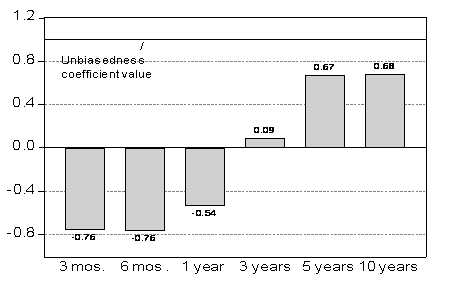
Figure 1: Panel beta coefficients at different horizons. Notes: up to 12 months, panel estimates for 6 currencies against US$, euro deposit rates, 1980Q1-2000Q4; 3-year results are zero-coupon yields, 1976Q1-1999Q2; 5 and 10 years, constant yields to maturity, 1980Q1-2000Q4 and 1983Q1-2000Q4 (last observation corresponds to exchange rate data). Source: Chinn (2006).
Guest Contribution: “Exchange rate forecasting on a napkin”
Today we are fortunate to present a guest post written by Michele Ca’ Zorzi (ECB) and Michal Rubaszek (SGH Warsaw School of Economics). The views expressed are those of the authors and do not necessarily reflect those of the ECB.
We have just released a new ECB Working Paper entitled “Exchange rate forecasting on a napkin”. The title highlights our desire to go back to basics on the topic of exchange rate forecasting, after a work-intensive attempt to beat the random walk (RW) with sophisticated structural models (“Exchange rate forecasting with DSGE models,”).
Incidences and Cumulative Mass Shooting Casualties Associated with Use of Semi-Automatic Rifles: The Last Ten Years
Reader Bruce Hall, commenting on the focus on mass shootings and semi-automatic weapon use, remarks:
The focus on the AR-15 is illogical.
Guest Contribution: “The Exposure of U.S. Manufacturing Industries to Exchange Rates”
Today, we’re fortunate to have Willem Thorbecke, Senior Fellow at Japan’s Research Institute of Economy, Trade and Industry (RIETI) as a guest contributor. The views expressed represent those of the author himself, and do not necessarily represent those of RIETI, or any other institutions the author is affiliated with.
On March 8th President Trump announced 10 percent tariffs on aluminum imports and 25 percent tariffs on steel imports. On April 2nd China retaliated by announcing tariffs of up to 25 percent on imports of pork, soybeans, and other products. The European Union is also considering retaliatory tariffs. This tit-for-tat conflict spawns uncertainty, raises prices of key inputs for downstream industries, forces companies to engage in time-consuming appeals to the government, and risks making American products toxic to hundreds of millions of nationalistic Chinese consumers. It is no wonder that Deardorff and Stern (1997) said that using tariffs to correct distortions is like performing acupuncture with a fork.
Things I Never Thought I’d Have to Explain on Econbrowser: Trade Creation/Trade Diversion
Suppose you (the UK) are in a tariff-ridden world, getting butter from your former colony and current Commonwealth partner New Zealand, the global low cost producer. Then you (the UK) decide to join a customs union that encompasses Denmark, which produces butter at a lower cost than the UK, but higher than New Zealand. In plain words, the tariffs between UK and Denmark on butter go to zero, while those between UK and NZ remain.
Is the UK better or worse off?
“(Trade) Peace For Our Time”
Not the phrase used by the White House, but I think the essence of the statement. From ActionForex:
THE WHITE HOUSE – Office of the Press Secretary
FOR IMMEDIATE RELEASE – May 19, 2018Joint Statement of the United States and China Regarding Trade Consultations