One of the ways economists have tried to estimate the effects of the Fed’s program of large-scale asset purchases (LSAP) is using event studies of how the market responds in the thirty minutes following Fed statements of changes in the program. Yesterday’s announcement from the Federal Reserve that it is starting a gradual process of reducing its balance sheet gives us one new data point for such efforts.
Continue reading
The great unwind begins
The Federal Reserve announced today that it will begin reducing the size of its balance sheet next month in very modest and deliberate steps. One reason the Fed is moving so slowly is that they don’t want a repeat of the May 2013 taper tantrum, in which a surprise hint that the Fed might slow the rate at which it would be growing its balance sheet led to a spike up in long-term interest rates. But there may also be another reason why the Fed is contracting its balance sheet so cautiously.
Continue reading
Cassidy-Graham Implications for Federal Health Spending
Even more draconian than outright repeal.
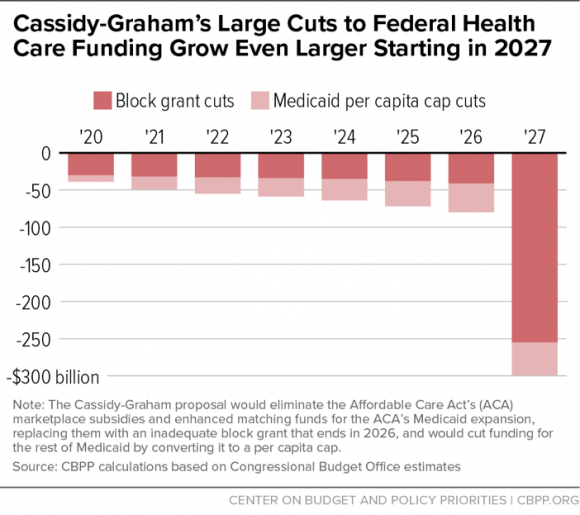
Source: CBPP.
Wildfires: Acres Burned, Suppression Costs
I received this message from USDA yesterday; it reminded me of some other adjustment costs of climate change.
U.S. Secretary of Agriculture Sonny Perdue today announced that wildland fire suppression costs for the fiscal year have exceeded $2 billion, making 2017 the most expensive year on record. Wildfires have ravaged states in the west, Pacific Northwest, and Northern Rockies regions of the United States this summer.
That’s just USDA; it doesn’t include Interior Department expenditures.
Wisconsin Employment Continues Downward in August
And is over 12,000 below April peak. Private nonfarm payroll employment is also declining, with previous months’ data revised down.
Guest Contribution: “EQCHANGE: A Worldwide Database on Actual and Equilibrium Effective Exchange Rates”
Today we are pleased to present a guest contribution written by Cécile Couharde (EconomiX-CNRS, University of Paris Nanterre), Carl Grekou (CEPII), Anne-Laure Delatte (CEPII, EconomiX-CNRS and CEPR), Valérie Mignon (EconomiX-CNRS, University of Paris Nanterre and CEPII) and Florian Morvillier (EconomiX-CNRS, University of Paris Nanterre).
The widening and persistence of current account disequilibria at the international level have refocused real exchange rate distortions at the core of international debates. What are the exchange rate adjustments needed to correct excessive imbalances? How to assess whether a currency is fundamentally misaligned, i.e. under- or over-valued? We introduce a new database, EQCHANGE, which includes nominal and real effective exchange rates, as well as equilibrium real effective exchange rates for more than 180 countries from 1973 onwards. It represents the longest and largest publicly available database on equilibrium exchange rates and corresponding misalignments.
12 Month Global Temperature Anomaly, August July 2017
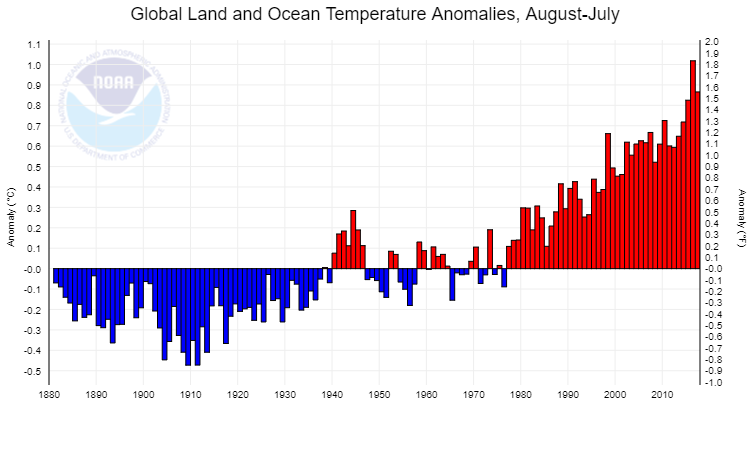
Corrected Source: NOAA, accessed 9/13/2017.
Update, 9/13, 8:15am Pacific: A common refrain is that it’s been hotter in the distant past. I think it’s important to remember that while there has always been variation in temperatures, a question is whether temperatures have changed so rapidly in such a short period of time in a time (post-dinosaur, e.g.). If adjustment costs are quadratic, well, the first derivative (gradient) matters. To that end, consider the following graph, and the movement over the most recent period.
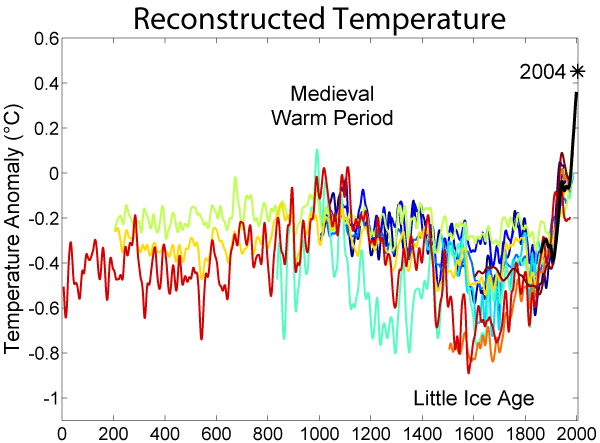
Source: CC BY-SA 3.0, [link].
Notice the steep ascent up to 2004; the global land/sea anomaly in Figure 1 is nearly 0.4 c higher in 2016 than 2004 (12 month thru December)..
Charlottesville, Eye Contact, and the Fed Chair Post
Is this how we should be choosing the Fed Chair? From WaPo:
Term Spread, September 5, 2017
As I was compiling background notes for the new semester, I found the current level and trend in the term spread of interest.
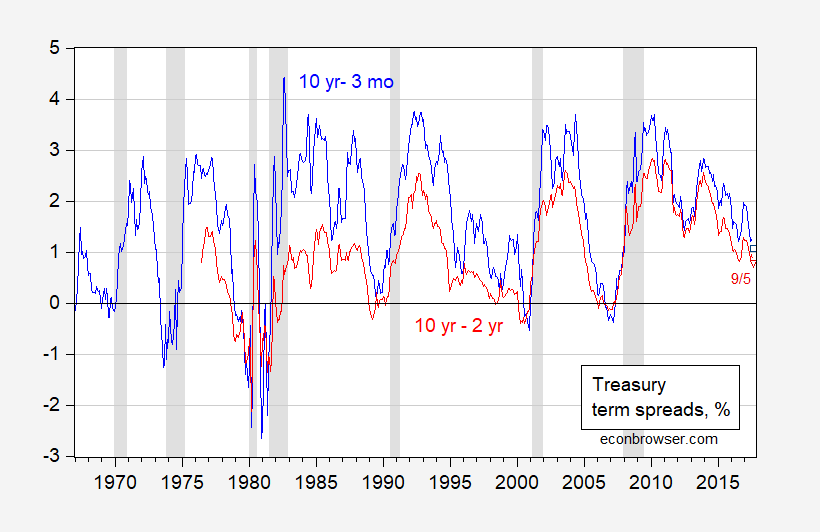
Figure 1: Ten year minus three month Treasury spread (blue), and ten year minus two year spread (red), %. Observations for September are 9/5. NBER defined recession dates shaded gray. Source: FRED, Bloomberg, NBER and author’s calculations.
Run the probit regression
recessiont+6 = -0.81 -0.474×(GS10-TB3MS)t + 0.065×TB3MSt + ut
over the 1967M01-2017M02 period (McFadden R2 = 0.24); the implied probability of recession is 10% for February 2018.
Using a specification without the level of the short rate included leads to a slightly higher probability, 14% or so.
The detail is also interesting. The spreads are smaller than they were in October 2016.
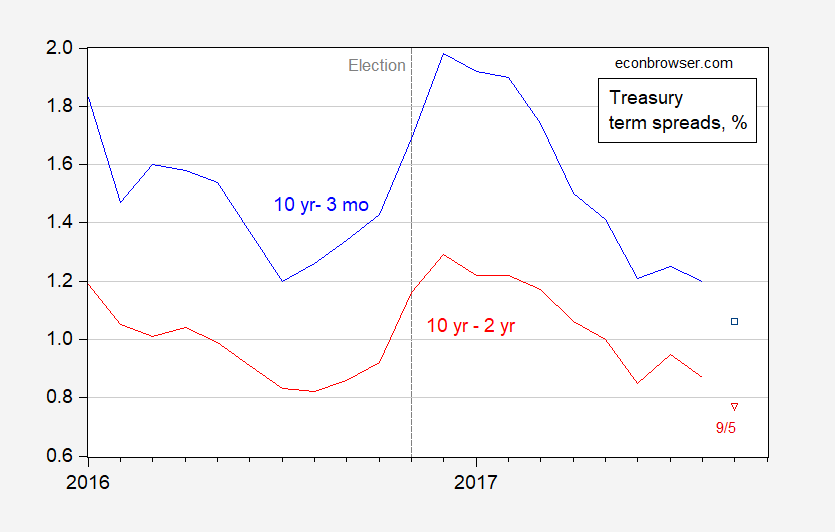
Figure 2: Ten year minus three month Treasury spread (blue), and ten year minus two year spread (red), %. Observations for September are 9/5. Source: FRED, Bloomberg, and author’s calculations.
Market Expectations Regarding Successful Raising of the Debt Ceiling
The market has apparently taken a dim view of the Administration’s ability to manage the debt ceiling issue. From Deutsche Bank (not online):

Truth be told, I am unsurprised.