From Washington Post:
GOP presidential hopeful Scott Walker said Monday that children of illegal immigrants who are born in the United States should not automatically receive U.S. citizenship.
From Washington Post:
GOP presidential hopeful Scott Walker said Monday that children of illegal immigrants who are born in the United States should not automatically receive U.S. citizenship.
Today we are fortunate to have a guest contribution by Helen Popper, professor of economics at Santa Clara University.
The 2% devaluation of the Chinese yuan on Monday, and subsequent 1.6% weakening on Tuesday, was variously described as surprising and stunning. I think it was to be expected, given China’s slowing growth, although there was no particular reason to believe Monday would be the day. In evaluating the effects, one has to first place the drop in context.
Today we are fortunate to have a guest contribution written by Jeffrey Frankel, Harpel Professor of Capital Formation and Growth at Harvard University, and former Member of the Council of Economic Advisers, 1997-99. A shorter version was published at Project Syndicate.
The politics of the The Kansas Experiment were recounted in Sunday’s NYT Magazine. Does the economic crash continue?
There’s been a remarkable surge in world oil production over the last year. And the United States is only part of the story.
Continue reading
Source: Donald J. Trump, 6 December 2013.
Here’s some data: Global surface anomaly, year-to-date (June):
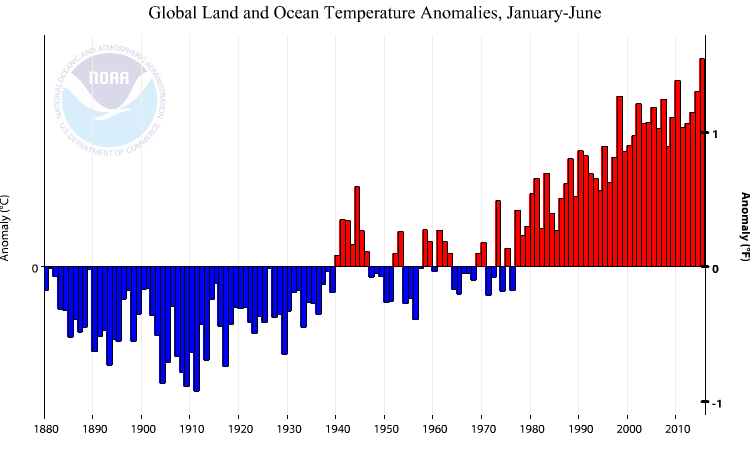
Source: NOAA
While Wisconsin lags, and statistically significantly so…
Has nonresidential fixed investment risen faster than GDP since the dot.com peak?
Following up on this post, estimating the consumption function